


 13 min



Weekly Markets Newsletter
- What You Need to Know This Week
- U.S. Equities
- Forex & Commodities
- Central Banks News and Fixed Income
What You Need to Know This Week
Key Takeaways
Global Markets Under Pressure as Technology Stocks Slide and Fed Rate Hike Expectations Rise
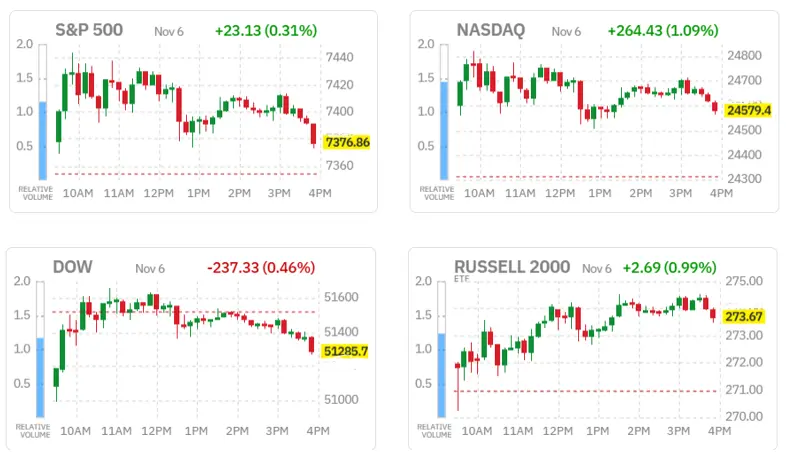
Global financial markets experienced a turbulent week as sharp losses in U.S. technology stocks, political uncertainty, and shifting monetary policy expectations weighed on investor sentiment. Wall Street recorded substantial weekly declines, with the Nasdaq Composite falling 3.4%, the S&P 500 losing 2.7%, and the Dow Jones retreating 0.9%, despite a partial recovery in technology shares on Friday.
The sell-off intensified following the Democratic victory in the U.S. midterm elections, raising concerns over potential regulatory restrictions on artificial intelligence and data-center investment. Growing doubts about elevated technology valuations and the profitability of substantial AI infrastructure spending further undermined market confidence, with selling pressure spreading across Asian and European equity markets.
Meanwhile, stronger-than-expected U.S. employment figures reinforced expectations of additional Federal Reserve tightening, supporting the dollar and pushing Treasury yields higher. These developments weighed on major currencies, including the euro and British pound, while gold benefited from safe-haven demand despite pressure from higher interest-rate expectations.
In fixed-income markets, government bond yields remained sensitive to inflation developments, central bank guidance, and changing risk appetite. Looking ahead, investors will closely monitor economic indicators, corporate earnings, and monetary policy signals to determine whether the recent market recovery can develop into a sustained rebound or whether further volatility lies ahead.
U.S. Equities
A Volatile Week Driven by AI and Political Uncertainty
U.S. equities ended a highly volatile week with significant losses, despite a technology-led rebound on Friday. The Nasdaq Composite recorded its fourth consecutive weekly decline and entered correction territory, reflecting mounting concerns over AI valuations, infrastructure spending, and potential regulatory changes.
The Nasdaq Composite closed Friday at 24,579.43 points, gaining 1.1% during the session but declining 3.4% over the week. The S&P 500 ended at 7,377.99 points, rising 0.3% on Friday while recording a 2.7% weekly loss. Meanwhile, the Dow Jones Industrial Average closed at 51,286.27 points, falling 0.5% on Friday and 0.9% for the week.
U.S. Midterm Elections and Market Volatility
The Democratic victory in the November 3 midterm elections initially triggered a strong rally on Wednesday, supported by President Trump's acceptance of the results and willingness to pursue bipartisan cooperation.
However, optimism quickly faded as investors reassessed the potential implications of a Democratic majority for technology regulation, particularly AI development and data-center expansion.
Thursday's Historic Technology Sell-Off
On November 5, the Nasdaq plunged approximately 5.5%, its steepest daily decline since April 2025, wiping out an estimated $2.5 trillion in market capitalization. The S&P 500 dropped 4.36%, while the Dow Jones lost approximately 1,833 points.
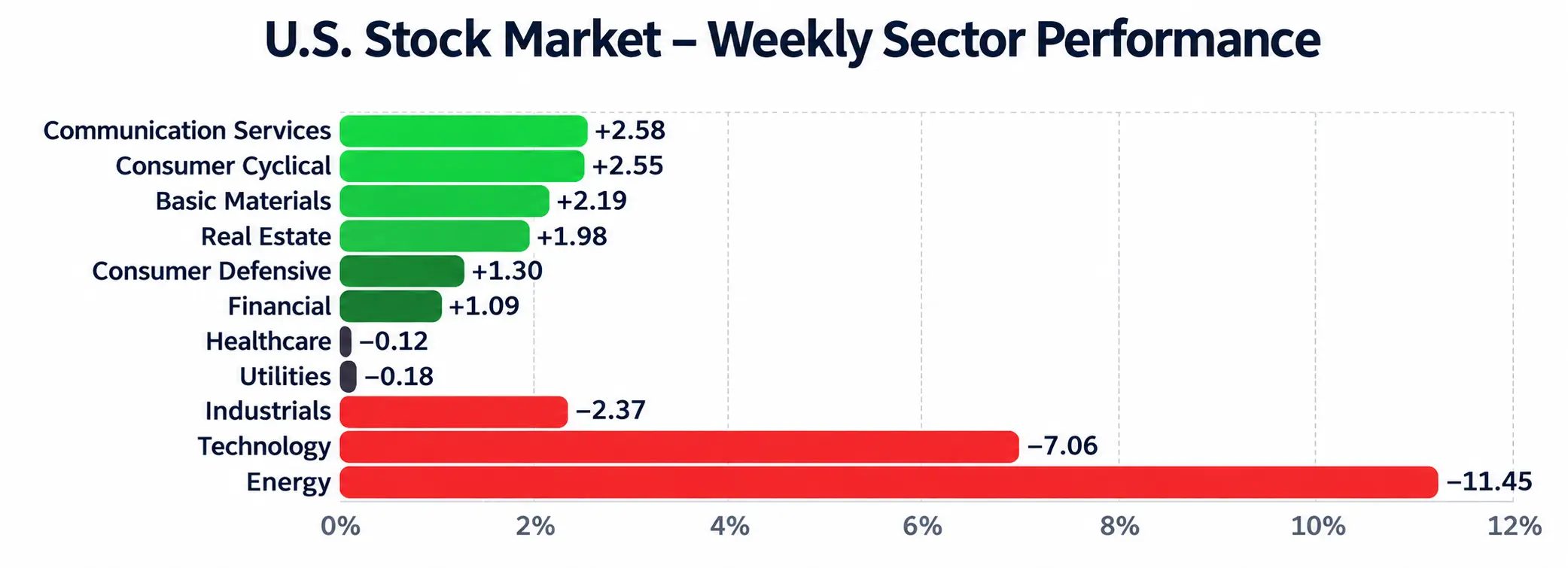
The sell-off was concentrated in technology and semiconductor stocks, with Nvidia falling 9.3%, AMD declining 17%, Broadcom losing 10%, and Micron dropping 17%. Disappointing corporate earnings and concerns about the profitability of massive AI investments intensified selling pressure.
Friday's Technology Rebound
Technology stocks recovered part of their losses on Friday, supported by renewed buying interest in semiconductor companies, AI infrastructure providers, and data-center operators. The Philadelphia Semiconductor Index surged 4.2%, following a decline exceeding 12% on Thursday.
Key stock performances included:
- Nvidia: +2.8%
- AMD: +11%
- Intel: +7.7%
- CoreWeave: +6.3%
Despite the rebound, the Nasdaq remained firmly negative for the week, indicating that investor confidence had not fully recovered.
Strong U.S. Employment Data and Fed Expectations
October's U.S. nonfarm payrolls exceeded expectations, while the unemployment rate declined to 4.1%, highlighting continued labor-market resilience.
The stronger employment figures reinforced expectations that the Federal Reserve could raise interest rates in December.
According to LSEG, the probability of a December rate hike increased to 78%, compared with 70% previously. Higher interest-rate expectations present an additional challenge for technology stocks, particularly companies with elevated valuations and substantial future capital-expenditure commitments.
Global Market Contagion
Thursday's Wall Street sell-off extended into Asian and European equity markets.
Asian technology stocks experienced particularly severe losses, with Japan and Taiwan under significant pressure. Taiwan's benchmark index entered bear-market territory, while South Korea's equity market triggered a circuit breaker amid heavy selling in major semiconductor companies, including Samsung Electronics and SK Hynix.
The MSCI Asia Pacific Index also recorded its sharpest intraday decline since 2025.
Market Outlook: AI Confidence Faces a Critical Test
Friday's rebound demonstrated that investors remain interested in the long-term growth potential of artificial intelligence. However, the week's sharp losses highlighted increasing sensitivity to technology valuations, regulatory uncertainty, corporate earnings, and interest-rate expectations.
The key question is whether AI-related earnings growth can justify the enormous capital investment already committed to the sector.
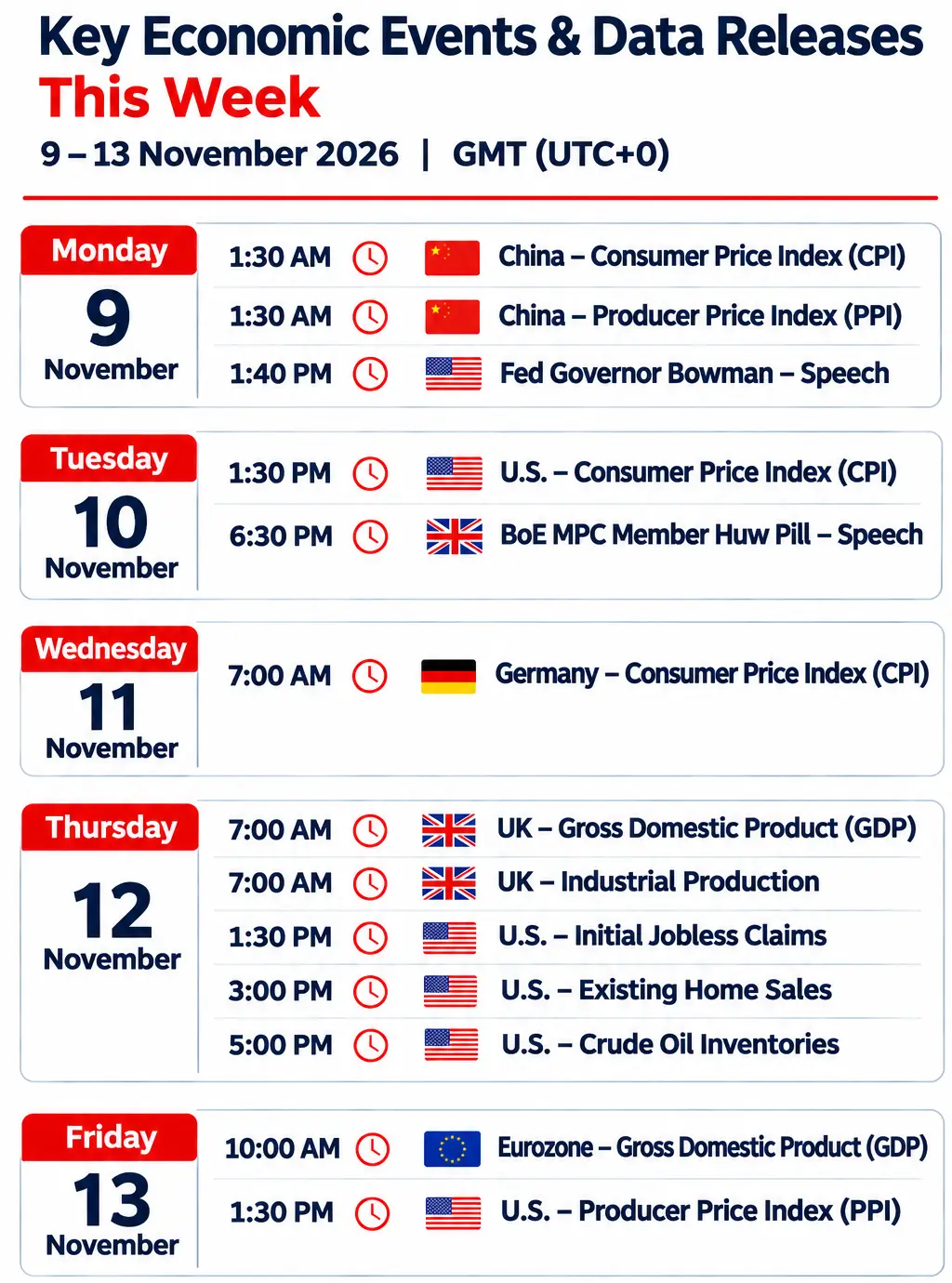
Looking ahead, investors will closely monitor Federal Reserve expectations, Treasury yields, corporate profitability, and potential regulatory developments to assess whether Friday's recovery marks the beginning of a sustainable rebound or merely a temporary technical bounce within a broader market correction.
Forex & Commodities
EUR/USD
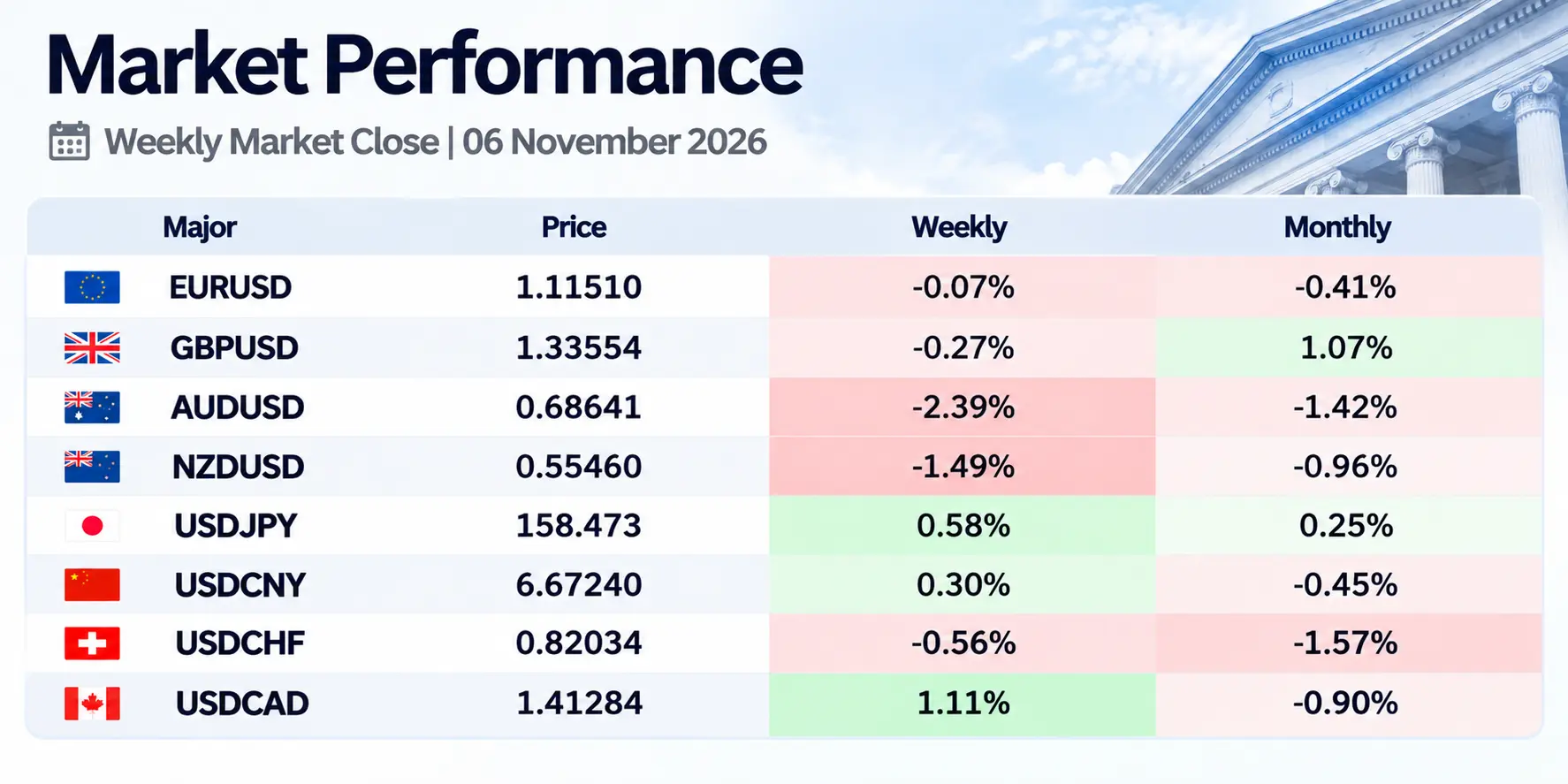
The euro extended its decline, falling below $1.115 and approaching its weakest level in several months, as stronger-than-expected U.S. employment data boosted the dollar and reinforced expectations of further Federal Reserve tightening. The greenback also benefited from safe-haven demand amid a global technology sell-off, fueled by concerns that the Democratic victory in the U.S. midterm elections could lead to tighter AI regulations and slower industry expansion.
Meanwhile, ECB President Christine Lagarde indicated that the central bank would closely monitor incoming economic data before deciding on a potential interest-rate hike in December. Although the ECB kept rates unchanged in October, several policymakers, including the governors of the German and Italian central banks, have signaled support for further tightening. Eurozone inflation accelerated to a three-year high of 4% in October, driven primarily by rising energy prices, strengthening the case for a December rate hike and potentially limiting further euro weakness.
Key Technical Levels to Watch
On the upside, initial resistance is located near 1.1255, corresponding to the upper Bollinger Band, followed by the July 28 low at 1.1353 and the more significant resistance at the 100-day SMA around 1.1415. A sustained break above this level could pave the way for further gains toward the August 7 high of 1.1581.
Conversely, immediate support stands near 1.1132, aligned with the lower Bollinger Band. A decisive break below this level could expose the psychological support at 1.1100, followed by the May 12, 2025 low at 1.0951.
- Over the past month, the Euro US Dollar Exchange Rate - EUR/USD has weakened 0.51%, and is down by 3.70% over the last 12 months.
GBP/USD
The British pound retreated below $1.335, pulling back from nearly two-month highs, as stronger-than-expected U.S. employment data strengthened the dollar and reinforced expectations of further Federal Reserve tightening. The greenback also benefited from increased safe-haven demand amid a global technology sell-off, driven by concerns that the Democratic victory in the U.S. midterm elections could lead to tighter AI regulations and slower industry expansion.
Meanwhile, investors continued to assess the Bank of England's latest monetary policy decision, which saw the central bank raise interest rates for the first time in more than three years. Governor Andrew Bailey warned that further rate hikes could be necessary unless the conflict in Iran comes to an end, prompting markets to fully price in three additional increases by November 2027.
The BoE also projected that inflation could peak at 4.9% in the second quarter of 2027, while its adverse scenario pointed to a sharper increase to 6.2% in the third quarter, reinforcing expectations of prolonged monetary tightening.
Key Technical Levels to Watch
On the upside, immediate resistance is located at the 61.8% Fibonacci retracement level near 1.3472, followed by the 78.6% retracement at 1.3562 and the recent cycle high around 1.3677.
Conversely, initial support emerges at the 50% Fibonacci retracement level of 1.3409, followed by the 20-period EMA near 1.3372. A sustained break below these levels could trigger further downside pressure toward the 38.2% retracement at 1.3345 and the 23.6% level near 1.3267, before exposing the more significant support at the cycle low of 1.3140.
- Over the past month, the British Pound has strengthened 0.99%, and is up by 1.39% over the last 12 months.
USD/CAD
The Canadian dollar weakened toward 1.41 against the U.S. dollar in November, pressured by disappointing domestic employment figures and stronger-than-expected U.S. labor market data. Canadian employment declined by 4,700 in October, compared with a sharper loss of 68,300 in September, but fell short of expectations for a 13,600 increase. Private-sector employment also dropped by 53,000, or 0.4%, marking its first decline since February and raising concerns about labor market weakness.
These developments could increase pressure on the Bank of Canada to consider monetary easing to support economic activity, potentially weighing further on the loonie. However, Canada's economy showed signs of resilience, with GDP expanding by 0.8% in the second quarter of 2026, following growth of just 0.1% in the previous quarter. Meanwhile, U.S. nonfarm payrolls increased by 165,000, exceeding expectations and strengthening the dollar amid prospects of a widening U.S.–Canada interest-rate differential.
On the monetary policy front, the Bank of Canada raised its benchmark interest rate by 25 basis points to 2.50% at its latest meeting, marking its first increase since 2023, while annual inflation reached 3.1% in September, slightly below the 3.2% forecast. Overall, the combination of weaker Canadian employment conditions and resilient U.S. economic data continues to support upward pressure on USD/CAD.
Key Technical Levels to Watch
On the upside, initial resistance is located at the 200-period SMA near 1.4120, followed by the horizontal resistance levels at 1.4130 and 1.4150. A sustained break above these barriers could pave the way for further gains toward the psychological level of 1.4200.
Conversely, immediate support is seen around the recent trading zone at 1.4119, followed by stronger support at 1.4070 and the 100-period SMA near 1.4035, where buying interest previously emerged. A decisive break below these levels could signal weakening bullish momentum and increase the likelihood of a deeper downward correction.
- Over the past month, the Canadian Dollar has strengthened 0.97%, but it's down by 0.49% over the last 12 months.
Gold
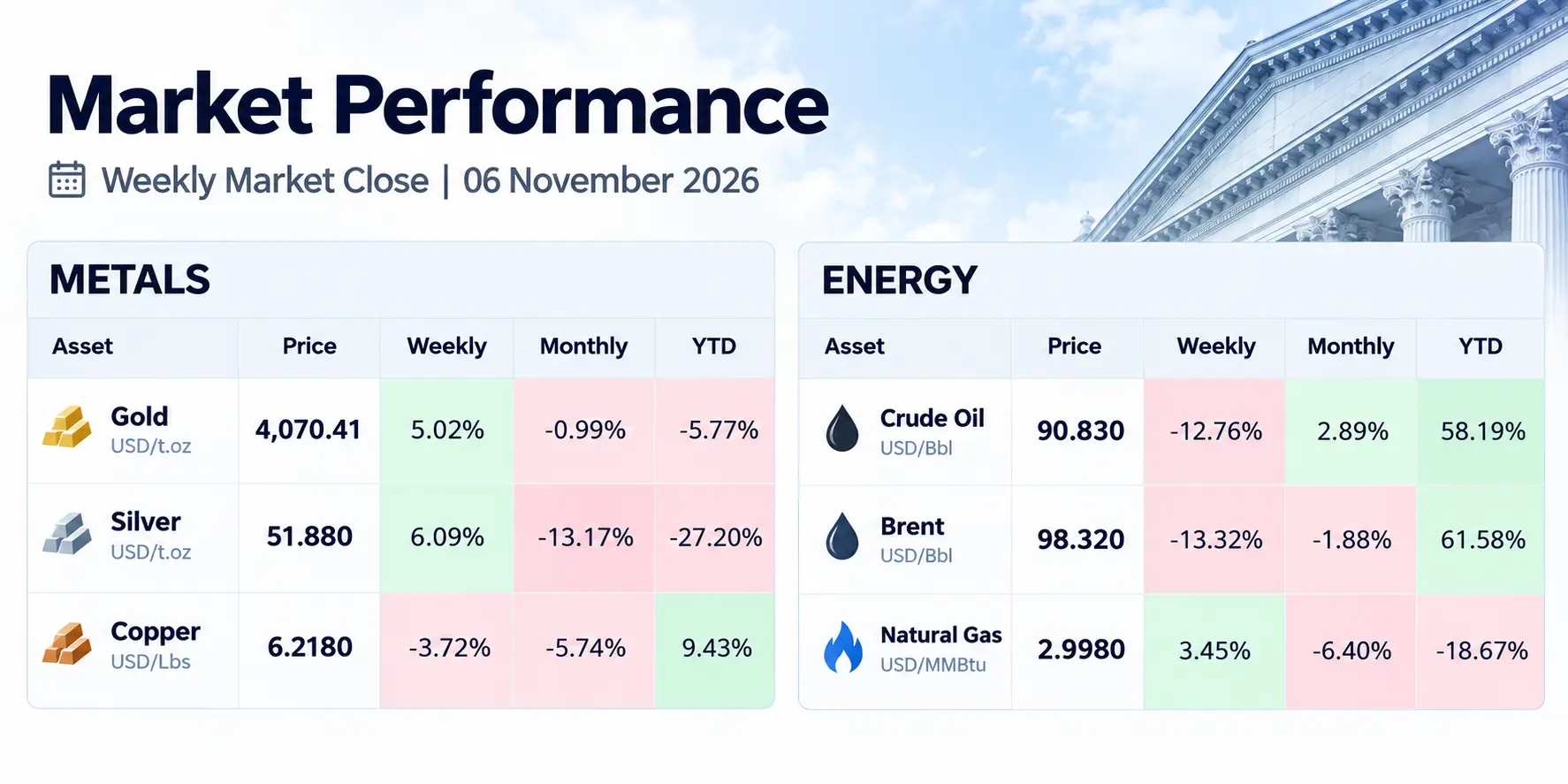
Gold prices retreated toward $4,050 per ounce on Friday, pressured by a stronger U.S. dollar and rising expectations of further Federal Reserve tightening following a stronger-than-expected October employment report. The U.S. economy added 165,000 jobs, significantly exceeding market forecasts of 65,000, while the unemployment rate unexpectedly declined to 4.1%. Employment figures for the previous two months were also revised upward by a combined 84,000, reinforcing signs of labor market resilience. Meanwhile, average hourly earnings increased by 0.4%, surpassing expectations of 0.3%, while renewed gains in crude oil prices added to inflationary concerns, further strengthening the case for a potential Fed rate hike in December.
Despite Friday's decline, gold recorded a weekly gain of more than 4%, supported by strong safe-haven demand amid heightened market volatility following the Democratic sweep in the U.S. midterm elections. The resulting sell-off in technology and AI-related stocks encouraged investors to shift toward defensive assets, helping gold maintain its positive weekly performance despite pressure from the stronger dollar and higher interest-rate expectations.
Key Technical Levels to Watch
On the upside, gold needs to break above the key resistance zone formed by the 100-day and 50-day Simple Moving Averages (SMAs) at $4,197 and $4,202, respectively, to confirm a continuation of the bullish momentum. A sustained move above this resistance area could pave the way for further gains toward the psychological level of $4,300.
Conversely, immediate downside support is located at the $4,000 psychological level, with a decisive break below potentially intensifying selling pressure and exposing the November 4 low at $3,919, followed by the October 30 year-to-date low at $3,879.
- Over the past month, Gold's price has fallen 0.99%, but it is still 1.74% higher than a year ago.
Central Banks News and Fixed Income
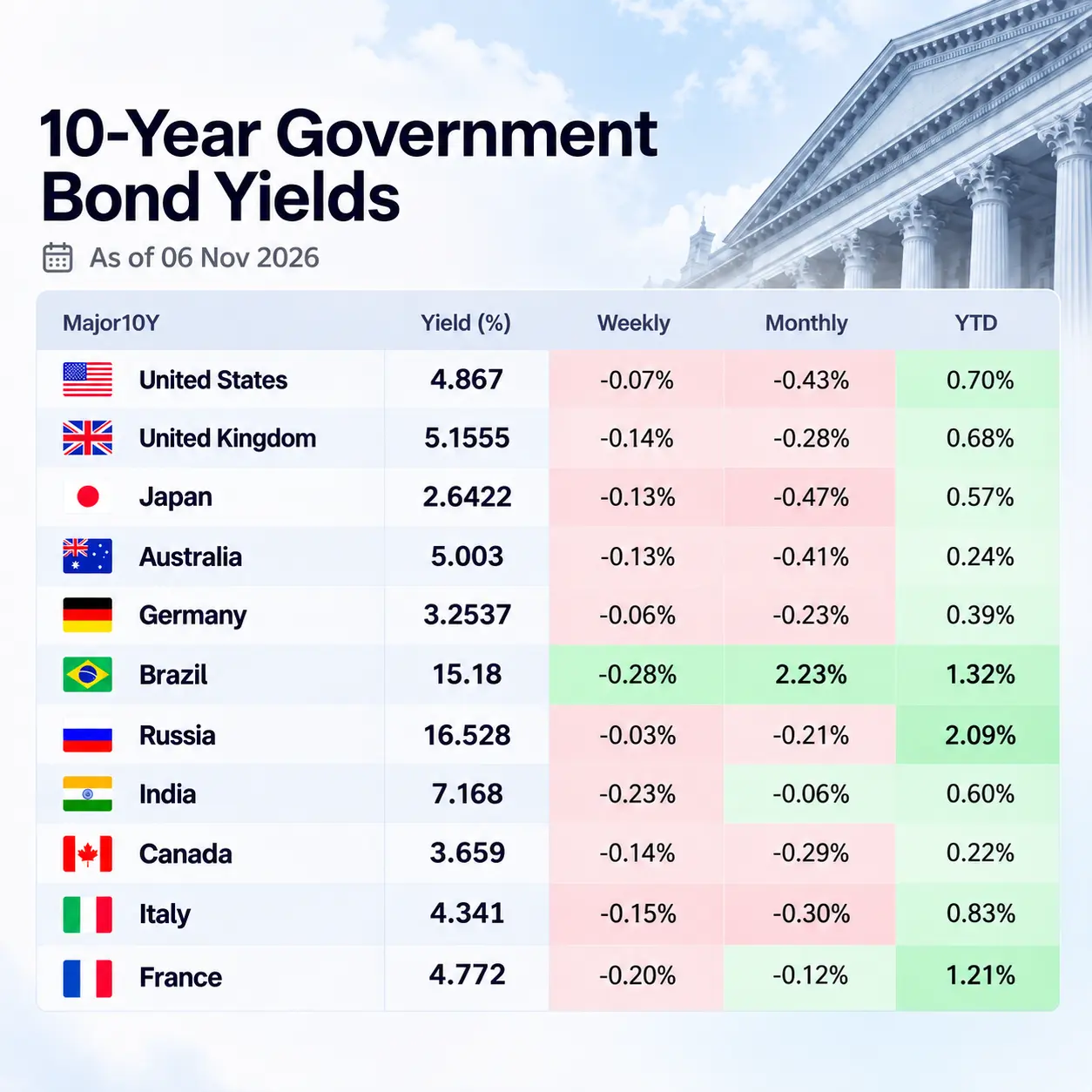
U.S. Treasury yields: The yield on the U.S. 10-year Treasury note climbed by as much as 6 basis points to 4.90% on Friday before easing to around 4.86%, as stronger-than-expected U.S. employment data reinforced expectations of a Federal Reserve interest-rate hike in December. The U.S. economy added 165,000 jobs in October, significantly exceeding forecasts of 65,000, while the unemployment rate declined to 4.1% and wage growth surpassed expectations, highlighting labor market resilience and suggesting that the economy could withstand higher borrowing costs as the Fed continues its efforts to contain inflation.
Meanwhile, a rebound in U.S. equities following the previous session's sharp sell-off reduced demand for safe-haven Treasury securities, placing additional upward pressure on yields. Investors also continued to assess the economic implications of the Democratic sweep in the U.S. midterm elections, particularly the possibility of fewer tax cuts, reduced government spending, and tighter regulations on artificial intelligence, which could weigh on technology investment and influence broader economic growth expectations.
France 10-Year Government Bond Yield: The yield on France's 10-year government bond (OAT) declined below 4.80%, supported by increased safe-haven demand as investors reduced their exposure to technology stocks following the Democratic victory in the U.S. midterm elections. French bond yields also followed U.S. Treasury yields lower, as the Democratic takeover of the House of Representatives reduced expectations of further deficit-expanding legislation under the Trump administration, easing concerns over U.S. government borrowing and supporting global bond markets.
However, persistent uncertainty surrounding France's fiscal outlook continued to weigh on investor confidence in French government debt, limiting the decline in yields. Meanwhile, accelerating eurozone inflation and increasingly hawkish signals from European Central Bank policymakers reinforced expectations of further monetary tightening. Although the ECB maintained interest rates unchanged at its latest meeting, several officials indicated that additional rate hikes could be necessary to contain persistent inflationary pressures and prevent rising prices from feeding into wage growth, potentially limiting further declines in European government bond yields.
The UK 10-year government bond (gilt): The yield on the UK 10-year gilt rose above 5.15%, rebounding from recent two-month lows and following U.S. Treasury yields higher, as stronger-than-expected U.S. employment data reinforced expectations of a Federal Reserve interest-rate hike in December. Nevertheless, global bond markets continued to benefit from safe-haven demand amid heightened equity market volatility, as investors reduced their exposure to technology stocks following the Democratic victory in the U.S. midterm elections, which raised concerns over tighter AI regulations and potential restrictions on infrastructure investment.
Meanwhile, investors continued to assess the Bank of England's latest monetary policy decision, which saw the central bank raise interest rates for the first time in more than three years. Governor Andrew Bailey indicated that further tightening could be necessary unless the conflict in Iran is resolved, reinforcing expectations of a prolonged restrictive monetary policy stance. Consequently, markets have increased their bets on additional rate hikes, with three further increases now fully priced in by November 2027.
Michel Saliby
Head of Market Research and Education at FxPro


